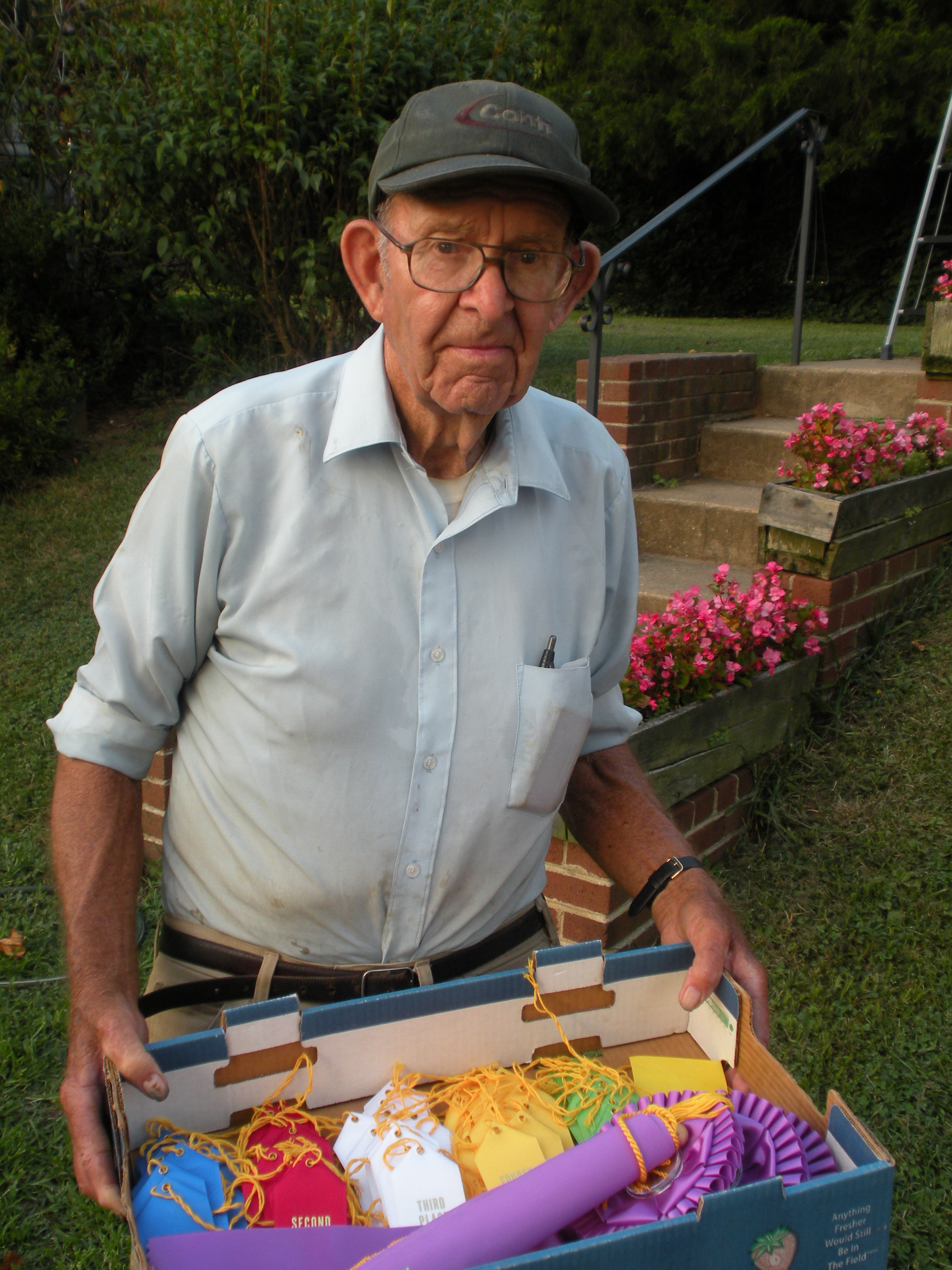
Another (short) Film About A Local Hero

A Short film about another local hero, Charlie Koiner, will be shown next month at Silver DocsFilm Festival. I was not involved in this production, but have filmed Charlie numerous times and had thought that a film needed to be done about him. The film will screen three times. Tuesday’s premiere is a free outside screening in The Ellsworth Plazza.

Charlie Koiner

Run time: 10 min. | USA

In the heart-warming short CORNER PLOT, 89-year-old Charlie Koiner cares for a one-acre piece of farmland that rests just inside the beltway of urban Washington DC. With help from his daughter, Charlie continues to work the land and share the fruits of his labor at the local farmer’s market. In a rapidly changing modern world, this unique farmer remains dedicated to the life he has always known.

9:30 PM Tue, Jun 22
Silver Plaza – Outdoor
screens with MICROCOSMOS | Marie Pérennou, Claude Nuridsany 1996

*****************************************************************************
9:00 PM Fri, Jun 25 AFI Silver Theater 3
screens with Shorts Program 5

*****************************************************************************
11:15 AM
AFI Silver Theater 2 Sat, Jun 26
screens with Shorts Program 5

Further details will be posted on the website I created for Charlie as they become available. We are hoping he will speak at one of the screenings.
http://koinerfarm.blogspot.com/

Great Documentary on a local DC hero

“Redemption Stone-The Life and Times of Tom Lewis” will have its U.S. Television premiere Monday May 24th on the Documentary Channel at 8:00 p.m. ET.

http://www.documentarychannel.com/

Redemption Stone introduces Tom Lewis, a storyteller of quiet power, who recounts the social upheaval and rebirth that shape his unique American journey. A spiritual vision inspires Tom to open an after-school safe haven called The Fishing School and to turn hardship into hope for the children in his community.
http://www.redemptionstone.net

Free Music

Jamendo is the world’s #1 platform for free and legal music downloads. I have reviewed it before, but thought I’d mention it again. It offers the largest catalog of music under Creative Commons licenses. For artists, it’s an easy and efficient way to publish, share and promote their music, and also to make money, through ad revenue sharing and commercial partnerships. For listeners, it’s like expanding your music library to the galaxies.

Discover the 33840 albums available for free and legal download by clicking here:

Scribd news

A very good document hosting site that I have reviewed before is Scribd. It is going to get even better. It is transitioning from Flash to HTML5.

HTML5 will run on iphones and ipads, unlike Flash. Plus it will be more expansive taking up the whole browser rather than sitting in a little window. Plus, it will download faster. In addition, the service is about to introduce compatibility with Google Docs. this will make Scribd much more usable and useful.

For more, see:
Scribd: HTML5 & The Future of Publishing

Collaborative Map

I made this cool interactive, collaborative map on Google today. It includes all of the art galleries and some (of the many) “hot spots” on H St.

See below or click here for the full-featured map: http://tiny.cc/Hstreet

Studio H Gallery and Workshop, 408a H street NE
Dissident Display, 416 H Street NE
City Gallery, 804 H Street NE upstairs
Gallery O/ H, 1354 H Street NE
Conner Contemporary Art, 1358 Florida Av NE
G Fine Art, 1350 Florida Av NE
Industry, 1350 Florida Av NE (upstairs)
Evolve Urban Arts Project, 1375 Maryland Av NE

Happy New Year!

Sometimes I share links to Time Magazine’s top ten list. This year I will just share one of David Pogue’s recommendations for best innovations in 2009. He is one of the people I follow on Twitter who seems to consistently have interesting and informative posts. And I’m not just saying that because he included five of my tweets in his new book, “The World According to Twitter.”

His weekly tech video are also good.

Here is what he says about readability:

“The single best tech idea of 2009, though, the real life-changer, has got to be Readability. It’s a free button for your Web browser’s toolbar (get it at lab.arc90.com/experiments/readability). When you click it, Readability eliminates everything from the Web page you’re reading except the text and photos. No ads, blinking, links, banners, promos or anything else. Times Square just goes away.”

“Readability makes the world online a calmer, cleaner, more beautiful place.”

Other folks I like to follow on Twitter:

http://twitter.com/scottsimpson (funny)

http://twitter.com/PCJournals (interesting links to Peace Corps blog posts)

http://twitter.com/mainjustice (what is really going on at the Justice Dept.)

http://twitter.com/collazoprojects (Editor of a travel blog)

Stoves for the Masses

You must get the print version of the December 28th edition of the New Yorker to read this article (excerpt below) about folks trying to save the world, one stove at a time. Something I spent two years doing in Guatemala in the late 1980s.
********************************
*******************************

From The NEW Yorker Blog, December 16, 2009

The Perfect Stove

Posted by Burkhard Bilger

This week in the magazine, I write about engineers who have set their sights on the low end: a ten-dollar stove that even the world’s poorest people can afford. In the past few years, though, industrial giants like Bosch-Siemens, British Petroleum, and Philips Electronics have all tried their hand at building more expensive and sophisticated devices—stoves that cost between twenty and a hundred dollars retail, and are clean enough to run indoors. The results have been mixed.

The Germans, at Bosch-Siemens, developed an elegant oil-burning unit called the Protos, but it never really took off. (It’s as noisy as a blast torch, I was told). The British, at BP, spent millions designing a stove that runs on pellets, then promptly abandoned the project and sold the design to an Indian company. The Dutch, at Philips, have just finished field tests of a stainless-steel fan stove, a prototype of which I tried out this fall. The Philips stove has a rechargeable fan in its base that works as a kind of bellows: it helps the fire light quickly and keeps it burning hot and clean. The stove that I used boiled a pot of water faster than my GE gas range, produced almost no smoke, and left only a thin residue of ash behind.

Even more promising is a stove designed by an Italian-American engineer named Nathaniel Mulcahy. The LuciaStove, as he calls it, is a gasifier made of beautifully injection-molded aluminum. It’s modular in design, so its most intricate parts can be packed flat and shipped inexpensively, while the rest can be manufactured locally. (In the Congo, the combustion chambers have been made of spent munitions shells.) Mulcahy, who is a former research director at Emerson appliances, claims that his stoves can cut fuel use nearly in half and burn fuel with ninety-three per cent efficiency. Whether they can also overcome the tetchiness inherent to gasifiers remains to be seen, in ongoing programs in Africa, Mongolia and Afghanistan.

Finally, Dean Still and the engineers at Aprovecho have joined with a start-up firm called Biolite to create a new generation of low-emissions stoves. Their design incorporates a thermoelectric fan designed by Jonathan Cedar and Alec Drummond, co-founders of BioLite. The fan runs without batteries or external electricity. Instead, it uses the heat from the fire to generate its own power. Cedar and the Aprovecho staff built the prototype in October and presented it for the first time at an international stove meeting in Bangkok, in November. The new stove reduces emissions by more than ninety per cent, compared to an open fire, and should cost about twenty dollars a unit to build. Best of all, it’s user-friendly: unlike other fan stoves, it has a side-feeding combustion chamber that’s easy to refuel. Aprovecho and BioLite hope to make it commercially available by 2011.

Twitter instead of Google?

Well I know that there are a lot of people still very resistant to using Twitter.  However, even if you have no intention of ever sending tweets, you need to know about and use Twitter.  I have been using Twitter for about 2 years.  Today, many companies and even government agencies and officials use Twitter as a primary means of direct communication to and from constituents.  The U.S. Department of Labor, the EEOC, The State Department, and more recently the Justice Department have all gotten on Twitter.

Even if you choose not to subscribe to any feeds, you can still use Twitter to Search the internet for interesting articles and discussions.

I am a huge fan of Google’s search engine.  Google’s advanced search template is very helpful.  However, there are certain research tasks that will yield better results by doing a Twitter Search, particularly up to the minute information and news stories from other countries.

Next time you are doing a Google search, try the same search here and see what you think: http://search.twitter.com/advanced

If there is an item you want to monitor, you can convert your twitter search to an RSS feed and subscribe to it using your feed reader.  While you can also do that with a Google Alert, the types of results you will get will be much different.  If you do not use or know what an RSS reader is check out https://wlerik.wordpress.com/2008/06/08/must-have-apps/

Montgomery victory gardens

Seems like a new non-profit group has sprung up to support community gardens and sustainable, local, food systems:

http://montgomeryvictorygardens.org/

See also http://www.revivevictorygarden.org/

I am a big supporter of local farming. My 90 year old neighbor Charlie is a good example of how productive a small urban plot of land can be. I made him a Website/blog, check it out: http://koinerfarm.blogspot.com/

Charlie watering baby lettuce seedlings

I am not much of a gardener myself, but Caitlin does grow some herbs on our balcony. When I was in Guatemala, I had a small garden. I also had some apple trees. All of my neighbors grew corn and black beans. Some grew wheat. Nearby in Almolonga and Zunil, they grew all sorts of vegetables, which could not be exported to the U.S. because of the high levels of pesticides they used.

Best Film of the year: The Cove

I saw the film today and also heard the producer speak. Here is an excerpt of the talk he gave at SilverDocs: http://boo.fm/b31943

It is a moving film called “The Cove,” about efforts to save dolphins.  Please take action by visiting http://www.takepart.com/thecove/

Below is a review I just read:

From: http://www.treehugger.com/files/2009/04/the-cove-trying-to-save-23000-dolphins-from-slaughter.php

The Cove – Trying to Save 23,000 Dolphins from Slaughter

by Jaymi Heimbuch, San Francisco, California on 04. 9.09

the the cove diver underwater with dolphins photo
Photo via TheCoveMovie.com

Each year, starting in mid-September, 23,000 dolphins are slaughtered in near secrecy in a cove in Taiji, Japan. Richard O’Barry, the leading dolphin trainer in the 1960s and trainer of the dolphins used in the TV series Flipper, has been trying to stop this slaughter for years. We covered the stories of activist Hayden Panettiere trying to expose the slaughter. And last year, we covered the story of a brave set of film makers lead by director Louie Psihoyos who have teamed up with O’Barry and other activists in an effort to show people the intolerable killings. They’ve now created a film called The Cove showing their efforts to get through the intense security and record what happens there.

the cove slaughter of dolphins photo

The Cove is a powerful documentation of more than just this mass killing of dolphins, whose meat is later labeled as some other type of larger whale and sent for sale in markets, despite the incredibly high levels of mercury it contains due to pollution. The film is also a story of the power of commerce, the government corruption, and the culture of loving something to death that all culminate at this tiny cove where anyone trying to see what happens is intimidated until they leave.

the cove film team photo

Psihoyos and his team undertook an operation to set up secret cameras and document what happens in the cove – the round-up, the selection of a few dolphins for sale to aquatic entertainment centers, and then the slaughter of every animal left in the ring of nets.

The International Whaling Commission does nothing to stop Japan’s extreme whaling habits. The citizens of Japan do nothing simply because it is kept under such tight wrap, people don’t even know that dolphin meat is being consumed. It has taken the activists involved in this film to get it as exposed as it has become so far.

The film is intense, it’s message clear and urgent, and its passion contagious. Right now, it is being screened in various locations, but needs funding to be completed and shown on a larger scale. And time is running out – the slaughter is set to start again this September.

If you want to see the film, try to catch one of these screenings. You can also watch snippits at TheCoveMovie.com. And, of course, if you want to take action immediately, there are ways to do that too through petitions and changes in your own daily life.