FILMOCRACY Winners Make a Statement!

After checking out these clips, go to the library and check out the book entitled Food Politics, by Marion Nestle.  I highly recommend it.

Repost of: Independent Lens Newsletter: June 23, 2008

KING CORN, one of this season’s favorite docs, provided the backdrop
for the first Filmocracy mashup contest, where we asked people to mix
it up, make a statement and answer the question: If you are what you
eat, what are you?

Many people used the powerful medium of film to illustrate their
point of view on the politics of food, using KING CORN clips and
footage from Getty Images. Participants uploaded their own clips as
well, and mixed it all up with the Eyespot online editing tool.

And without further adieu… the Filmocracy contest winners are:

Grand Prize
“Corn King Takes Over the World” by Kylee Darcy

Highest Rated
“The Politics of Food” by Brandon Savoie

Most Popular
“And So It Is” by Ananta

Watch at:
http://www.pbs.org/filmocracy

Grand prizewinner Kylee Darcy won $1,000 and her stop-motion animated
short, “Corn King Takes Over the World,” will be screened throughout
the country at Indie Lens Community Cinema events this fall. She also
gets a KING CORN DVD, soundtrack and other fabulous corn-free prizes!
The most popular and highest rated videos get cool prizes too.

Darcy, age 19, is a health conscious sophomore at UC Berkeley who is
passionate about food politics. She came across the Filmocracy
contest while conducting research about the relationship between
nutrition and exercise with mental health. For her entry, Darcy
created her own hand-drawn animation and mixed it up with KING CORN
clips and archival images to make a bold and colorful statement about
the politics of food.

The KING CORN filmmakers chose the grand prizewinner, and Eyespot
viewers gave the highest ratings to “The Politics of Food” by Brandon
Savoie. Savoie, a 22-year-old student and forklift operator from
Louisiana, has “a passion for indie filmmaking,” and entered the
contest to comment on the fast food controversy he had read about on
the Internet. “Even if I didn’t win,” he said, “I thought it would be
a good opportunity to help inform others of the irresponsibility of
the major fast food companies.” The winner of Most Popular
designation, “And So It Is” by Ananta, has not responded to our email
request.

Watch the Independent Lens Filmocracy contest shorts winners (all
under 3 minutes) at:
http://www.pbs.org/filmocracy

From the Personal Democracy Forum (PDF08)

Repost from:

Daily Digest: Power Corrupts. PowerPoint Corrupts Absolutley.
By Nancy Scola, 06/24/2008 – 3:54pm

This is Day Two of the 2008 Personal Democracy Forum and we’ll be (mostly) devoting the Daily Digest to a recap of what’s going down at the conference, being discussed in the halls, and heating up the back channels. We’ll return to our regular digest format tomorrow.

Visual presentation virtuoso Larry Lessig at a text-only mid-morning press conference here at PdF ’08: “I’m a little lost because I don’t have slides.”

Google evangelist and wise guy Vint Cerf: “PowerPoint corrupts. PowerPoint corrupts absolutely.”

(Yes, we know Larry uses Keynote in his presentations. But still, that’s a great line.)

Bad weather kept keynoter Elizabeth Edwards away from New York City in body but she was still able to appear at PdF ’08 via Skype, which preformed remarkably well. The upside of Elizabeth staying in North Carolina? Her husband, John, popped into view of Elizabeth’s laptop camera [here’s a photo] and stuck around to say a few words. The New York TimesKatharine Seely reports on the tech-focused discussion between Elizabeth and the PdF crowd.

NPR’s Sunday Soapbox “field vlogger” Jacob Soboroff conducted video interviews with MySpace IMPACT’s Lee Brenner, the Huffington Post’s Arianna Huffington and Open Left’s Matt Stoller. Also in NPR land, Soapbox’s senior producer Davar Ardalan responds to Jay Rosen’s take on notes on “semi-pro” journalism presented at a PdF panel yesterday morning and posted to TechPres last night, saying that digital integration “brings with it many philosophical questions about editorial control and the ethical rules we have all been trained to follow.”

Over on the tech blog ArsTechnica, Julian Sanchez responds to yesterday’s discussion over the modern media’s “fake neutrality,” to borrow a phrase from Arianna.

Silicon Alley responds to McCain advisor Mark Sohoo’s defense yesterday of his candidate’s relationship with the Internet. The Guardian UK also has coverage of the session under the in-no-way-judgmental headline “Republicans Admit Obama is Winning the Online Battle.” Ooh, this just in: source material — video of the exchange between Mark and John Edwards’ online staffer Tracy Russo that has had people talking since.

CNN’s iReport has a station set up here and the conference and has gone live with interviews and coverage with attendees.

Virtual reality pioneer Mark Pesce gave a keynote this morning on “hyperpolitics — American style” that both Twitter and room tone seemed to indicate was very well-received. If the reporting on the speech strikes you as slightly fuzzy, that’s because I unfortunately arrived at the talk where there was only about three minutes left; no worries, though, because Mark has generously posted the full text of his presentation.

PdF’s Alison Fine has great coverage of Doug Rushkoff talk on “The New Renaissance” and Morely Winegard’s presentation on the civic engagement of the millennial generation.

PC World covers the unveiling of Internet for Everyone, a new Free Press-engineered push for universal broadband launched at PdF ’08 this morning. Nancy Scola (hey, that’s me) has a quick guide to the the bite-sized arguments made by the project’s supporters, from Vint Cerf to Writers Guild East president Michael Winship to TechPres contributor David All.

CNET’s Caroline McCarthy reports on Larry Lessig’s exhortation to the PdF crowd to not fall into the “four-year trap” of keeping a close watch on politics and politicians only when election time rolls around.

Nancy Scola (again, me) reflects upon a session featuring Mayhill Fowler where the OffTheBus contributor called for bloggers to agree to some “code of the road” that creates a safe, off-the-record space for press.

ThePoint.com’s Alex Steed is doing some granular liveblogging of the conference.

Of course, there’s more going on than we can possibly capture. So check out the Twitter stream tagged #pdf2008 on Summize.

1st Amendment? Never heard of it, says FCC

repost from

http://blogs.law.harvard.edu/Media Re:public

encouraging collaborative, practical research and analysis of the new media (r)evolution

The FCC says they want to make it easy for someone to deliver wireless broadband for free. But, as we say here at Berkman, there is free as in beer, and free as in speech. And the FCC’s new idea is UNFREE as in speech. Why? Because the license for the spectrum they want to auction requires a mechanism that “filters or blocks images and text that constitute obscenity or pornography and…any images or text that otherwise would be harmful to teens and adolescents. For purposes of this rule, teens and adolescents are children 5 through 17 years of age. As someone pointed out in a gahering here at Berkman just now, that puts the United States right up there with China. Further, the rule states, “should any commercially-available network filters installed not be capable of reviewing certain types of communications, such as peer-to-peer file sharing, the licensee may use other means, such as limiting access to those types of communications.”

The problem is the ruling makes the Internet like broadcast television or radio, where we still can’t use George Carlin’s seven words, when it really should be like the telephone, where it’s none of your @O#*$U# business what I want to talk about. I am neither a lawyer nor a technologist, but I know this is BAD. I read the text (actually I just searched for the word “pornography” and read that bit) and then went here to tell the FCC how I felt. (The comments submission form is very tricky, the 2 relevant dockets are 07-195, and 04-356, but I found it rejected my attempts to put them in myself (got an error message after submitting) so I clicked on proceedings and search for them.

That’s the basic Internet freedom part.

There’s also the sleazy background part about the M2Z, the company that’s pushing this. Business Week points out that one of the two founders of M2Z is a former FCC official. The company’s site encourages visitors to send letters to Congress and the FCC tell them to support “free, family-friendly, nationwide broadband.” Wendy suggested they rename it the “free, family-friendly, FILTERband.”

A Tale of Two Jobseekers (video)

For wider screen video playback (without obstruction) click here!

Video (dramatization) response to U.S. Department of Labor (DOL) policy and rule changes. More information below: In a nutshell DOL is mandating that the State Workforce Agencies (SWAs) not refer farmworkers to jobs without doing employment eligibility verification screening. SWAs are revolting against this requirement, because it requires them to single out predominantly Hispanic customers for added scrutiny. Other job seekers are not treated this way and SWAs do not have the resources or the desire to do this. DOL is threatening to withhold appropriations due to the SWAs if they do not cooperate.

Disclaimer: I created this work on my own time in my individual capacity and it does not represent the opinion of anyone other than myself.

The E-Verify tentative non-confirmation in the dramatization should not have caused a delay in the referral, but such delays will probably occur if there is not adequate training (so I inserted a practical lesson regarding what not to do), but in reality there are so many steps in the process that could cause substantial delay and inconvenience to farmworkers that I decided not to re-shoot that part and left it as a teachable moment. I should have made the two week delay occur when the job seeker was sent away the first time. Perhaps he could have come back with a receipt for a replacement SS card and/or LPR card, and Mr. Smith could have told him that SWAs can not accept
receipts and that he needed to come back when he received a replacement SS card or LPR card. Then if the new regulations were in effect (and the 50% rule was no more), the farmer would have been able to refuse the referral as occurring after the start date.

This dramatization highlights only a few of the many changes that DOL is proposing to the H-2A regulations that will have a negative impact on MSFWs. Click Here for more detailed comments I submitted to DOL in opposition to the proposed rule.

Comments on the U.S. Department of Labor’s proposed rule changes on the H-2A program are due by April 14, 2008.

Add your own comments & See comments already submitted:
http://www.regulations.gov/fdmspublic/component/main?main=DocketDetail&d=ETA-2008-0001

See also:
From Farmwoker Justice Website:

http://www.fwjustice.org/Immigration_Labor/h2anews.htm#F

Join “Change Congress” Movement!

cc-badge-1.png

Change Congress website

Slide show explaining the Change Congress movement:

http://lessig.org/blog/2008/03/change_congress_launched.html

Additional media coverage from yesterday’s announcement:

Wired: “Stanford Law Professor Larry Lessig Bets ‘Wikipedia’ Approach Will Transform Congress”
http://blog.wired.com/27bstroke6/2008/03/stanford-law-pr.html

San Jose Mercury News: “Tech law expert to take on Congress”
http://www.mercurynews.com//ci_8635224?IADID

Continue reading “Join “Change Congress” Movement!”

Get My Vote: NPR’s User-Generated Political Commentary Initiative

From Andy Carvin’s Waste of Bandwidth by acarvin on 3/12/08

Eighteen months ago this week, I [Andy] started working at NPR as senior
product manager for online communities. [Andy] spent a lot of that time
working with shows on social media experiments and educating NPR staff
about the role Web 2.0 can play in journalism. But [Andy] also spent much
of the last year working on a big project – one that would have NPR
dive head-first into user-generated content. The project is called Get My Vote, an [they have] just launched a public beta of the website.

As the name suggests, the project is based around a basic premise:
what will it take for political candidates to get my vote? Every person
has their own reasons for selecting a particular candidate, their own
litmus tests, and we’re asking the public to articulate this in the
form of open letters to the candidates. Using Get My Vote, you can
upload your own commentary – audio, video or text – and talk about what
issues or concerns will drive you to the ballot box. NPR is then
planning to incorporate these commentaries into our shows throughout
the rest of the election cycle.

[They have] also designed the project in such a way that local stations –
both NPR and PBS stations – can create their own Get My Vote
initiatives on their websites by embedding Get My Vote widgets. That
way, a station can localize the project. A station in Arizona, for
example, might create a local version of Get My Vote focusing on
immigration perspectives, while a station in Massachusetts might
challenge users talk about what it would take for local mayoral
candidates to get their vote. So while most users might end up talking
about the presidential candidates, I’m hoping it’s used for state and
local races as well.

On the Get My Vote homepage,
you’ll see that we’re using a tag cloud prominently. These tags are
submitted by users when they upload their commentaries. For example, a
commentary from an Iraq war vet about healthcare for vets might include
tags like “Iraq,” “healthcare” and “Walter Reed.” The more often a
particular tag is used by commentators, the larger it appears in the
tag cloud. That way, you can get a sense of what topics and ideas are
being referenced most often by commentators. Clicking any tag also will
show you all commentaries associated with that word or phrase.

The site is now in public beta. This means that anyone can now
access the site, upload their own commentaries and explore the site in
general, but we’re still working out a few bugs and other minor fixes.
[They’re] hoping that if you have any problems with the site you’ll alert
[them] through the contact form.
Over the next few weeks [they’ll] continue to tweak the site, and soon
after that, we expect some of our shows to begin using it on air.

So when you get a chance, please visit npr.org/getmyvote, upload your own commentary and please let [them] know what you think. [Their] team is really eager to hear what you have to say. -andy

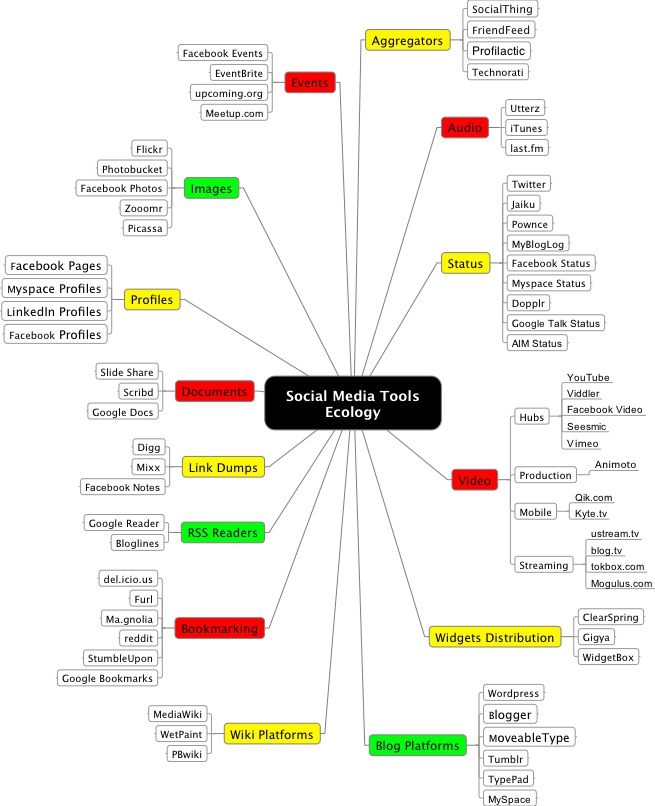
www.scribd.com (free on-line books & document sharing)

Scribd Redefining Online Documents

Scribd Platform

Scribd (pronounced skribbed) has developed a new iPaper platform you can use free, to share, store, and/or read documents.  Previously the only way to share a document was by email, sending a direct link to the document or attaching the whole document. With Scribd you can email a document without having to actually open an email program… Scribd also provides you with an embed code that allows you to share a doc by embedding it in another website. Using a flash format, it avoids file incompatibility problems that commonly arise when you send someone a document in a program (or version) that the recipient does not have. As an example, here is a 354 page book from internet law guru, Lawrence Lessig that you can read free.

Link to Document:

Title: “Lawrence Lessig – Freeculture