It’s now possible to visit about a dozen art museums around the world without ever leaving the comfort of your home.


It’s now possible to visit about a dozen art museums around the world without ever leaving the comfort of your home.
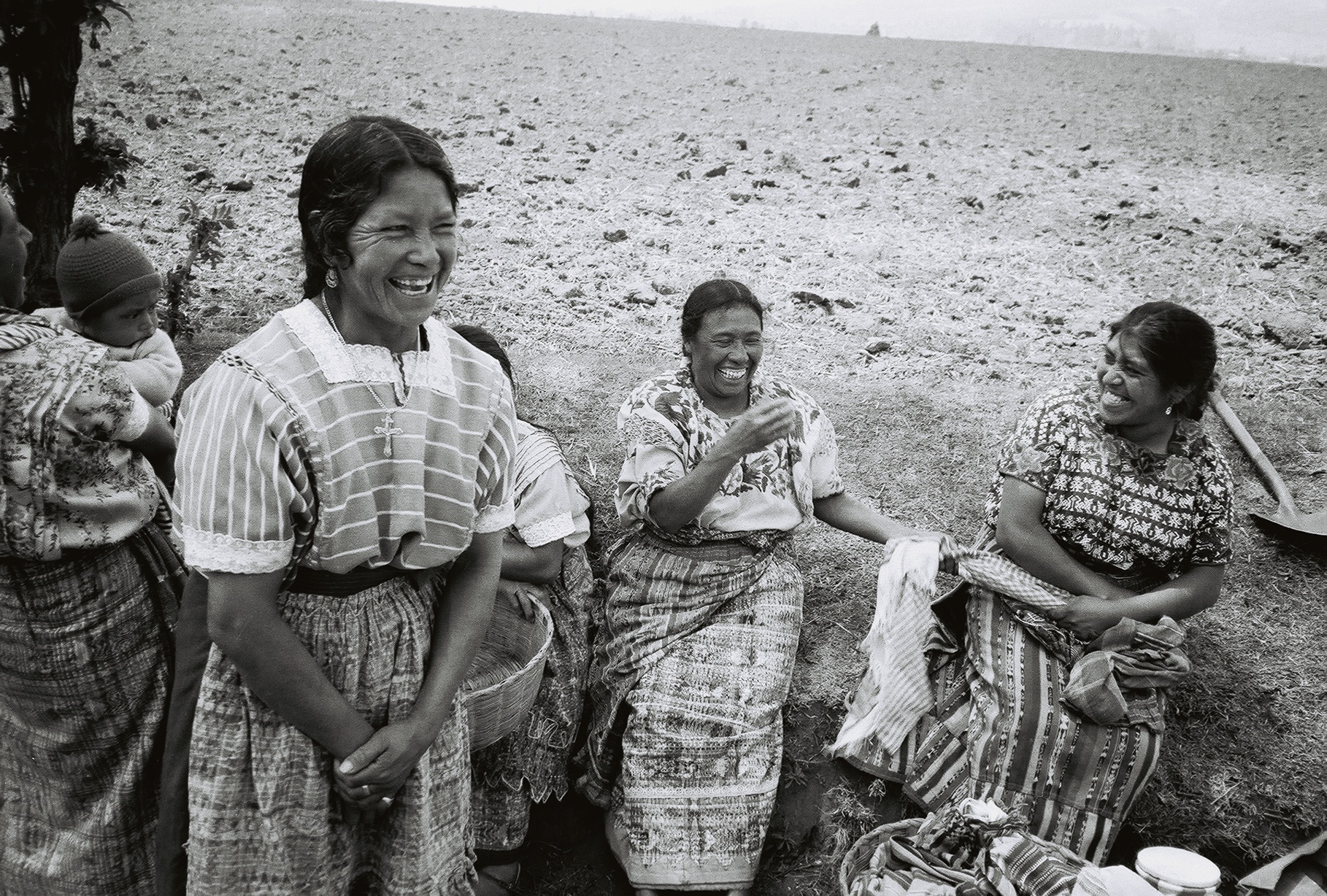
I just donated to a project that is building a water tank at a school in the neighborhood where I used to live in the late 1980s, when I was a Peace Corps Volunteer. At the time, I took this photo. I wonder what these women are up to now?
The project was funded in advance by Appropriate Projects which is an initiative of Water Charity, conceived to slash through the red tape and get projects done immediately.
Access to safe water is a human right, and they are fighting to achieve this goal for every person on this planet. they don’t sit around while people are dying and suffering from illness due to lack of water, contaminated water, and unsanitary conditions.
They use appropriate technology, meaning that the simplest and least-expensive methods are utilized to bring about the biggest impact at the least cost.
They do not deal with studies, reports, evaluations, nitpicking, reviews, administration, overhead, talk, delays, processes, procedures, format, overseeing, micro-directing, or excuses.
They start with the understanding that there are about 8,000 Peace Corps Volunteers stationed in over 74 countries around the globe. Each Volunteer is living in a city or community making a great contribution toward world peace.
Each Volunteer is competent and dedicated, having gone through a rigorous selection process, and having trained for the tasks to be done.
Each Volunteer has identified crucial projects that will affect the lives of those around him, but remain undone due to lack of funds.
Each Volunteer has the skills and capacity to manage the projects and funds, and complete the projects on time and within budget.
The projects submitted to Appropriate Projects by Volunteers are small, but they indeed have a big impact.
At the same time, there are millions of individuals around the globe who would like to do the right thing, to help those in need, and to make the world a better place to live.
Your contribution will bring to being a needed project in a distant place. It will affect the lives of individuals and communities, by letting them have the necessities of life.
Join The fight. Adopt a project.
I made this cool interactive, collaborative map on Google today. It includes all of the art galleries and some (of the many) “hot spots” on H St.
See below or click here for the full-featured map: http://tiny.cc/Hstreet
Studio H Gallery and Workshop, 408a H street NE
Dissident Display, 416 H Street NE
City Gallery, 804 H Street NE upstairs
Gallery O/ H, 1354 H Street NE
Conner Contemporary Art, 1358 Florida Av NE
G Fine Art, 1350 Florida Av NE
Industry, 1350 Florida Av NE (upstairs)
Evolve Urban Arts Project, 1375 Maryland Av NE
You must get the print version of the December 28th edition of the New Yorker to read this article (excerpt below) about folks trying to save the world, one stove at a time. Something I spent two years doing in Guatemala in the late 1980s.
********************************
*******************************
This week in the magazine, I write about engineers who have set their sights on the low end: a ten-dollar stove that even the world’s poorest people can afford. In the past few years, though, industrial giants like Bosch-Siemens, British Petroleum, and Philips Electronics have all tried their hand at building more expensive and sophisticated devices—stoves that cost between twenty and a hundred dollars retail, and are clean enough to run indoors. The results have been mixed.
The Germans, at Bosch-Siemens, developed an elegant oil-burning unit called the Protos, but it never really took off. (It’s as noisy as a blast torch, I was told). The British, at BP, spent millions designing a stove that runs on pellets, then promptly abandoned the project and sold the design to an Indian company. The Dutch, at Philips, have just finished field tests of a stainless-steel fan stove, a prototype of which I tried out this fall. The Philips stove has a rechargeable fan in its base that works as a kind of bellows: it helps the fire light quickly and keeps it burning hot and clean. The stove that I used boiled a pot of water faster than my GE gas range, produced almost no smoke, and left only a thin residue of ash behind.
Even more promising is a stove designed by an Italian-American engineer named Nathaniel Mulcahy. The LuciaStove, as he calls it, is a gasifier made of beautifully injection-molded aluminum. It’s modular in design, so its most intricate parts can be packed flat and shipped inexpensively, while the rest can be manufactured locally. (In the Congo, the combustion chambers have been made of spent munitions shells.) Mulcahy, who is a former research director at Emerson appliances, claims that his stoves can cut fuel use nearly in half and burn fuel with ninety-three per cent efficiency. Whether they can also overcome the tetchiness inherent to gasifiers remains to be seen, in ongoing programs in Africa, Mongolia and Afghanistan.
Finally, Dean Still and the engineers at Aprovecho have joined with a start-up firm called Biolite to create a new generation of low-emissions stoves. Their design incorporates a thermoelectric fan designed by Jonathan Cedar and Alec Drummond, co-founders of BioLite. The fan runs without batteries or external electricity. Instead, it uses the heat from the fire to generate its own power. Cedar and the Aprovecho staff built the prototype in October and presented it for the first time at an international stove meeting in Bangkok, in November. The new stove reduces emissions by more than ninety per cent, compared to an open fire, and should cost about twenty dollars a unit to build. Best of all, it’s user-friendly: unlike other fan stoves, it has a side-feeding combustion chamber that’s easy to refuel. Aprovecho and BioLite hope to make it commercially available by 2011.
I saw the film today and also heard the producer speak. Here is an excerpt of the talk he gave at SilverDocs: http://boo.fm/b31943
It is a moving film called “The Cove,” about efforts to save dolphins. Please take action by visiting http://www.takepart.com/thecove/
Below is a review I just read:
From: http://www.treehugger.com/files/2009/04/the-cove-trying-to-save-23000-dolphins-from-slaughter.php
 on 04. 9.09
Photo via TheCoveMovie.com
Each year, starting in mid-September, 23,000 dolphins are slaughtered in near secrecy in a cove in Taiji, Japan. Richard O’Barry, the leading dolphin trainer in the 1960s and trainer of the dolphins used in the TV series Flipper, has been trying to stop this slaughter for years. We covered the stories of activist Hayden Panettiere trying to expose the slaughter. And last year, we covered the story of a brave set of film makers lead by director Louie Psihoyos who have teamed up with O’Barry and other activists in an effort to show people the intolerable killings. They’ve now created a film called The Cove showing their efforts to get through the intense security and record what happens there.

The Cove is a powerful documentation of more than just this mass killing of dolphins, whose meat is later labeled as some other type of larger whale and sent for sale in markets, despite the incredibly high levels of mercury it contains due to pollution. The film is also a story of the power of commerce, the government corruption, and the culture of loving something to death that all culminate at this tiny cove where anyone trying to see what happens is intimidated until they leave.

Psihoyos and his team undertook an operation to set up secret cameras and document what happens in the cove – the round-up, the selection of a few dolphins for sale to aquatic entertainment centers, and then the slaughter of every animal left in the ring of nets.
The International Whaling Commission does nothing to stop Japan’s extreme whaling habits. The citizens of Japan do nothing simply because it is kept under such tight wrap, people don’t even know that dolphin meat is being consumed. It has taken the activists involved in this film to get it as exposed as it has become so far.
The film is intense, it’s message clear and urgent, and its passion contagious. Right now, it is being screened in various locations, but needs funding to be completed and shown on a larger scale. And time is running out – the slaughter is set to start again this September.
If you want to see the film, try to catch one of these screenings. You can also watch snippits at TheCoveMovie.com. And, of course, if you want to take action immediately, there are ways to do that too through petitions and changes in your own daily life.
Peace Corps Volunteer Katie McKenna wins Ordinary Hero Award for work with Water Charity in Guatemala: http://tinyurl.com/lg3hnq
http://blogs.law.harvard.edu/mediarepublic/category/cappucino/
encouraging collaborative, practical research and analysis of the new media (r)evolution
You should read Global Voices Online. You should write
for them. You should re-publish Global Voices stories from around the
world in whatever medium you produce. You should give them money.
Why? Because how will you find out what Bahraini Mahmood Al Yousif thinks about Obama’s choice of Egypt for his speech unless Amira tells you?
I keep asking myself why did Obama choose the most
repressive regimes in the Middle East to honour not only with his
presence, but also to use as a launchpad for his Utopian vision of a
peaceful and democratic Middle East? A vision that will continue to
remain as illusive as a desert mirage for us Middle Easterners.Then I try to select an alternate of the 22 Arab countries where he
could have used instead, but I fail to find a single one which could be
worthy of such an occasion.
– Bloggers React to Obama’s Address
 Or how would you find out about Mariam Zouaghi,
a Tunisian student sentenced to six years in jail for her online
activities? (search for her Google News turns up 3 articles, none in
English) without Global Voices Advocacy?
Global Voices is important to me not because it brings us “citizen
media” from around the world. As I have opined repeatedly, I don’t care
whether media is “citizen” or “mainstream” and I live for the day when
those words (as Henry Jenkins proposed so eloquently here at Beyond Broadcast) have gone the way of the term “horseless carriage.”
I care about good stories and authentic perspectives. And I care
about the lives of people in countries that mass-market legacy media in
my country ignore except when there’s a war or a US economic or
diplomatic interest at stake.
Full disclosure: I’m friends with many of the people who make Global
Voices what it is and I’m writing this today in response to an
interesting challenge that could help bring some more money to Global
Voices. But I’m not doing it to help my friends, I’m doing it because I
know how hard they work, how many amazing new projects they’d like to
do and how important they are to the project of bulding the
cross-border connections that we all need to become global citizens.
It is election time in India. Painted walls tells stories of political
loyalty. India is rich with political symbols some more obvious than
others. Congress’ symbol — THE HAND. Photo by Carol Mitchell via Global Voices and Flickr.
This blog post is part of Zemanta’s “Blogging For a Cause” campaign to raise awareness and funds for worthy causes that bloggers care about. Check it out.
Last night Leo & Dimitar helped me hang some paintings and photos for Harry’s exhibit at Artomatic 2009
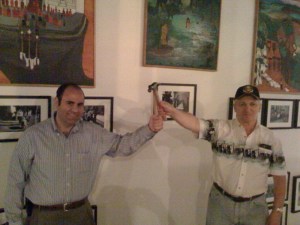
The annual Artomatic festival runs May 29 to July 5 above the Navy Yard Metro station (Green Line – exit closest to National’s Stadium). There will be four bars inside, exhibits by hundreds of local artists, and two stages for live music & dance performances. Harry’s exhibit is on the second floor near the stage. It is on the north side of the building, with windows overlooking the Capitol.
See http://www.artomatic.org/participate/faq for more information
Charlie Koiner is almost 90 years old, yet he has an amazing farm in downtown Silver Spring that supplies the whole neighborhood (and beyond) with an amazing variety of fruits and vegetables almost year-round. Below is a video I shot recently where we talk a bit about Montgomery County’s new initiative to promote community gardens. Although one site has been removed from consideration, the initiative is going strong and the county is on the lookout for appropriate locations. I am thinking of doing a documentary about Charlie. If you know him and/or have any ideas for the documentary, please let me know by adding a comment to this blogpost.
(wait for video to load and then click play)
 Worthy Mouse Clicks